
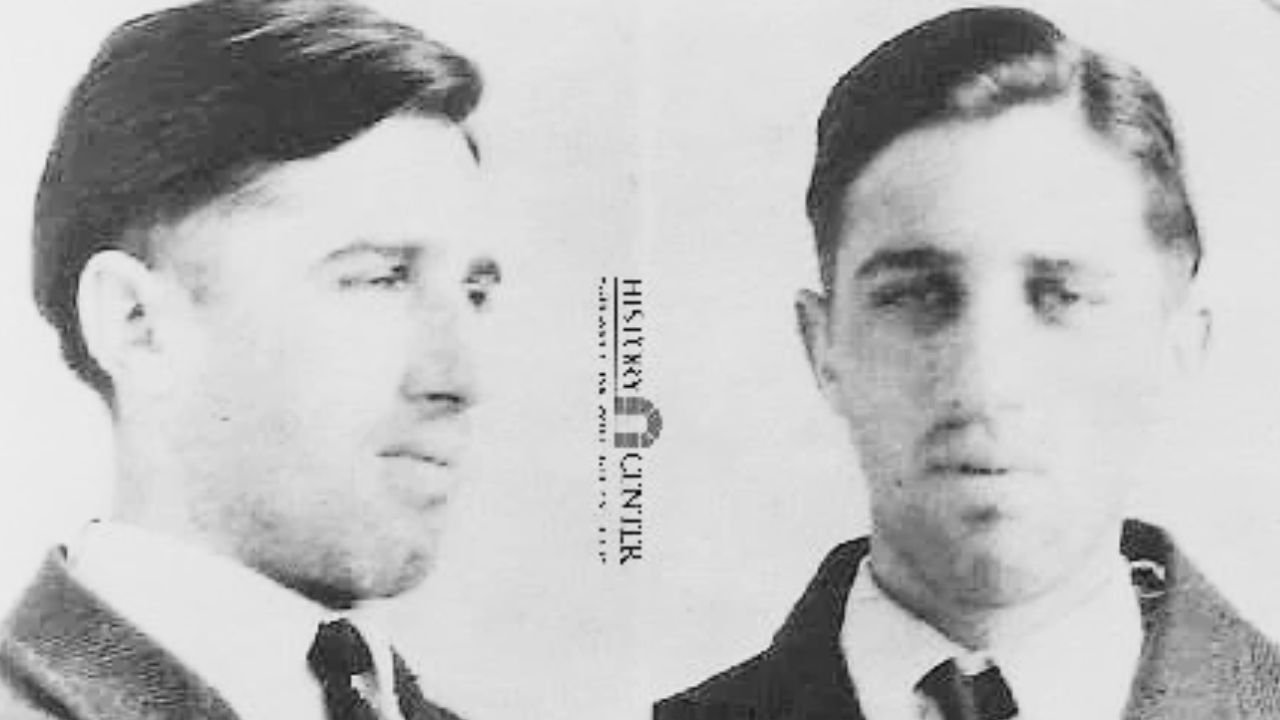
If you’ve found a “Homer Van Meter” in your family tree or on a genealogy platform, you may have stumbled into one of American crime history’s more recognizable names. But that connection may not mean what you think it does.
Multiple men named Homer Van Meter appear in records across Indiana and Ohio. Some are related to each other. Some are not. And only one of them is the notorious bank robber who ran with John Dillinger in the 1930s.
This article covers who Homer Virgil Van Meter was, who his family members were, and how to tell the different Homer Van Meters apart in genealogical records.
Who Was Homer Virgil Van Meter?
Homer Virgil Van Meter was an American bank robber born in Fort Wayne, Indiana. Most sources place his birth around December 3, though the year is listed as either 1905 or 1906 depending on the source — Wikipedia uses 1905, while MyHeritage lists 1906. Neither can be confirmed as definitively correct, so it’s worth keeping both in mind when searching records.
He became known as an associate of John Dillinger and Baby Face Nelson during the early 1930s. The three were part of a broader Midwest outlaw network that was active during the Great Depression, when bank robberies across Indiana, Wisconsin, and neighboring states made national headlines.
Van Meter’s criminal career ended on August 23, 1934, when he was killed by police in St. Paul, Minnesota. His body was returned to Fort Wayne, and he is buried at Lindenwood Cemetery there.
One small but telling detail: MyHeritage’s genealogical profile for Homer Van Meter lists his occupation as “Bank Robber.” That’s an unusual entry for a genealogy platform, but in this case, it’s accurate.
His Parents, Siblings, and Fort Wayne Roots
Homer Virgil Van Meter came from a working-class Midwestern family with roots in Ohio before settling in Indiana.
His father was Cary B. Van Meter, a railroad brakeman and conductor who worked for the Baltimore & Ohio Railroad and later the Nickel Plate Railroad. Multiple sources describe Cary as an alcoholic, which is noted in biographical accounts of Homer’s early life. His mother was Julia Miller.
Homer had two siblings: a brother named Harry and a sister named Helen.
The family’s roots stretch back further into Ohio. Cary’s father — Homer Virgil’s paternal grandfather — was Perry H. Van Meter, born in 1837 in Putnam County, Ohio. Perry was a Civil War veteran who served in Company D of the 189th Infantry. He married a woman named Anna M. Hollis, and the family eventually moved through Allen County, Ohio before the next generation landed in Fort Wayne, Indiana.
A genealogy blog focused on Defiance County, Ohio traces this family line directly: Perry H. Van Meter → Cary B. Van Meter → Homer V. Van Meter. It’s a straightforward three-generation path from a Civil War soldier to a Depression-era bank robber.
Homer L. Van Meter — The Uncle Who Shared the Name
Here is where genealogy research gets tricky. There was another man named Homer Van Meter in the same family — and he lived in the same city and is buried in the same cemetery.
Homer L. Van Meter was born on August 29, 1872, near Antwerp, Ohio. He was Cary B. Van Meter’s brother, which made him Homer Virgil’s uncle. That’s roughly a 33-year age gap between uncle and nephew.
Homer L. lived a very different life from his nephew. He worked as a real estate agent in Fort Wayne — a respectable, entirely ordinary career. He died on April 23, 1924, more than a decade before his nephew was killed by police in St. Paul.
The Defiance County genealogy blog even wrote a post about him titled “The Not So Notorious Homer L. Van Meter,” which says a lot about how easily he gets overshadowed by his more infamous relative.
What makes this especially confusing for researchers: both men share a similar name, both lived in Fort Wayne, and both are buried at Lindenwood Cemetery. If you’re reading a list of burial records without paying attention to birth years and middle initials, it’s easy to mix them up.
The simplest way to tell them apart is by dates. Homer L. was born in 1872 and died in 1924. Homer Virgil was born around 1905 or 1906 and died in 1934. Their occupations also differ sharply — real estate agent versus bank robber.
Other Men Named Homer Van Meter in the Records
The confusion doesn’t stop at uncle and nephew. Genealogy platforms like MyHeritage, Ancestry, and FamilySearch list several other men named Homer Van Meter, and they’re easy to mix up if you’re not careful.
Homer Van Meter (1909–1980)
Ancestry.com includes a profile for a Homer Van Meter born February 10, 1909, in Fort Wayne, Indiana. He was the son of Roy J. Vanmeter and Agnes P. Hubbard. He died on May 7, 1980, in Ruskin, Hillsborough County, Florida.
This man is clearly not the bank robber. The dates alone settle it — the Dillinger associate died in 1934, while this Homer lived until 1980. But because both were born in Fort Wayne and share the same name, the profiles can appear side by side in search results, which leads to understandable confusion.
Homer Virgil Van Meter (born 1895 in Oklahoma)
FamilySearch includes a profile for a Homer Virgil Van Meter born in 1895 in Oklahoma. This individual appears to come from an entirely separate family line — not the Indiana-Ohio Van Meter branch at all. It’s a reminder that the name wasn’t limited to one family or one region.
The Van Meter family had a pattern of reusing the name Homer across generations, similar to how many families cycle through names like “John Jr.” or “James III.” When a name gets reused in the same community, and especially when multiple people with that name end up in the same city or cemetery, genealogical records become genuinely difficult to read.
A Practical Way to Tell Them Apart
When you find a “Homer Van Meter” profile, check these details before drawing any conclusions:
- Birth year and location — the bank robber was born around 1905 or 1906 in Fort Wayne
- Death date and location — he died August 23, 1934, in St. Paul, Minnesota
- Parents — his father was Cary B. Van Meter, a railroad worker
- Middle name or initial — “Virgil” or “V.” points to the gangster; “L.” points to the uncle
- Occupation — some profiles list “Bank Robber,” which narrows it down immediately
Cemetery records can also help. Both Homer L. and Homer Virgil are buried at Lindenwood Cemetery, so burial location alone won’t tell you which Homer you’re looking at. But combining burial data with birth and death years will.
What the Van Meter Family Story Actually Tells Us
Taken together, the Van Meter family covers a wide range of American life across the 19th and early 20th centuries. Perry H. Van Meter served in the Civil War. His son Cary worked the railroads in Indiana. His brother Homer L. built a career in real estate. And his son Homer Virgil became one of the more recognizable names in Depression-era crime history.
That kind of range — soldier, laborer, businessman, criminal — isn’t unusual for large extended families spread across multiple generations. Economic hardship, local opportunity, and personal choices all shaped very different outcomes for men who shared a name and a bloodline.
For anyone doing genealogy research on this family, stories like this are worth reading carefully on platforms like Start Of Biz, where historical profiles and family context can add meaning to the bare facts in a records search.
Final Thoughts
If you’ve encountered a “Homer Van Meter” in your family research, don’t assume it’s the Dillinger associate without checking the details. Multiple men with that name appear in Indiana and Ohio records, and some of them share not just a name but a city and a cemetery.
The bank robber Homer Virgil Van Meter is well documented — born around 1905 or 1906 in Fort Wayne, killed in St. Paul in 1934, buried at Lindenwood Cemetery. His uncle Homer L. Van Meter was a real estate agent who died in 1924. And other men named Homer Van Meter appear in records from the same era with no confirmed connection to either of them.
Good genealogy research means slowing down, comparing dates, checking occupations, and not letting a famous name lead you to a conclusion the records don’t actually support.