
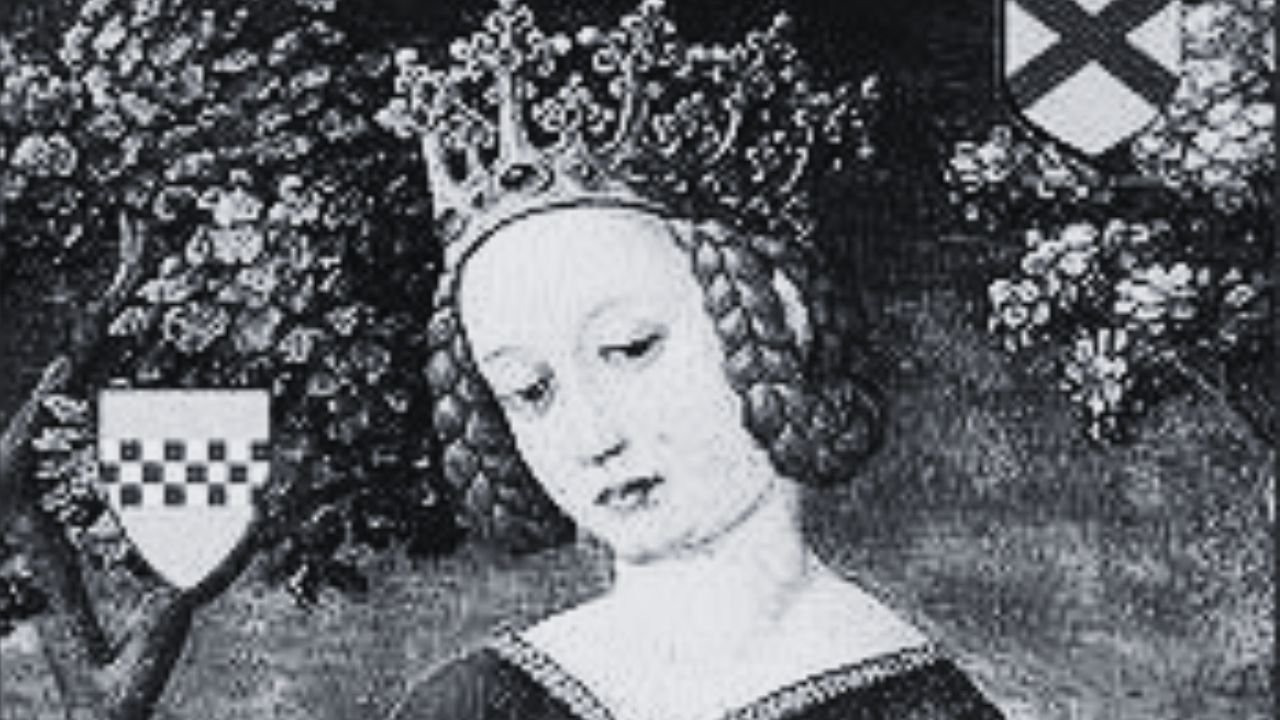
Most people know Robert the Bruce as the warrior king who fought for Scottish independence. But fewer know the name of the woman who gave him his first child — and, through that child, helped create an entire royal dynasty.
Her name was Isabella of Mar. She lived a short life, left behind almost no personal records, and died before her husband became king. Yet without her, the story of the Scottish monarchy looks very different.
This article covers who Isabella was, where she came from, why her marriage to Robert the Bruce mattered, and how her only known child changed the course of Scottish and British royal history.
Who Was Isabella of Mar?
Isabella of Mar was born around 1277, most likely near Kildrummy Castle in Aberdeenshire, Scotland. She is also recorded in some sources as Isabella nic Domhnaill and Isabella de Mar. She died in December 1296, shortly after giving birth to her only known child.
It is worth being honest here: very few contemporary records about Isabella survive. The details we have — her birth year, her birthplace, her parentage — come from later chronicles and modern genealogical research. Sites like FamilySearch, Geni, and MyHeritage record her birth as circa 1277 at Kildrummy Castle, and these details are widely accepted. But they are best described as commonly accepted rather than absolutely proven.
What is not in doubt is her historical position. She was the first wife of the man who would become Robert I, King of Scotland. And the daughter she left behind would reshape the Scottish crown for centuries.
Her Parents and the Noble House of Mar
Isabella came from one of Scotland’s most powerful noble families. Her father was Domhnall I — also called Donald — the Earl of Mar. He was not just a regional nobleman. He was one of the Guardians of Scotland, a council of powerful figures who governed the country during the succession crisis that followed the death of King Alexander III in 1286.
That made Domhnall a central player in one of the most politically charged moments in Scottish history. The question of who would next sit on the Scottish throne was being fought over by competing claimants, and the Guardians held real influence over how that question was answered.
Isabella’s mother is generally identified as Helen, also recorded as Elen ferch Llywelyn. She was an illegitimate daughter of Llywelyn ab Iorwerth — better known as Llywelyn the Great, the Prince of Wales. This is a detail that often surprises people. Through her mother, Isabella carried Welsh princely blood alongside her Scottish noble lineage.
That combination would turn out to matter a great deal, not just for Isabella herself, but for the royal line she helped create.
The Marriage to Robert the Bruce
Isabella married Robert the Bruce around 1295. She was approximately 18 years old. At that point, Robert was not yet king — he was an ambitious Scottish nobleman with a strong claim to the throne, but the crown was still far from certain.
The marriage was not simply a personal choice. It was a political alliance. The Earl of Mar — Isabella’s father — supported the Bruce claim to the Scottish throne. Joining the two families through marriage strengthened that support and gave Robert a powerful ally among the Scottish nobility.
The Stewart Society, which maintains detailed records on this period, frames the match explicitly as politically advantageous for both families. There is also a later legend, noted by the same source, that Isabella and Robert were “much in love.” That tradition exists, and it is worth mentioning. But it should be understood as legend, not documented history.
Scotland at the time was in turmoil. The death of Alexander III had left no clear heir. The subsequent dispute over succession — known as the Great Cause — drew in England’s King Edward I and set the stage for the Wars of Scottish Independence. Robert the Bruce was navigating this environment carefully, and a marriage into the House of Mar was a meaningful move.
Marjorie Bruce — The Daughter Who Changed Everything
Isabella and Robert the Bruce had one known child: a daughter named Marjorie Bruce, also called Princess Marjorie. Isabella died in December 1296, shortly after Marjorie’s birth. According to tradition, she was buried at Paisley Abbey, a Cluniac monastery that later became closely associated with the Stewart family.
Robert the Bruce later remarried. His second wife was Elizabeth de Burgh, and they had several children together. But it was Isabella’s line — through Marjorie — that carried a very specific dynastic consequence.
Marjorie Bruce grew up and married Walter Stewart, the 6th High Steward of Scotland. Their son, born in 1316, became Robert II of Scotland in 1371. He was the first monarch of the House of Stewart — the royal family that would go on to rule Scotland, and eventually Britain, for generations.
Think about what that means in simple terms. Isabella of Mar lived only 19 years. She had one child. That child’s son founded a royal dynasty. And through that dynasty, the Stewart and later Stuart monarchs of Britain trace their lineage back through Marjorie, through Isabella, and through the combined Scottish and Welsh noble blood that Isabella carried.
Isabella is, in straightforward genealogical terms, the grandmother of Robert II and a founding ancestress of the House of Stewart.
Why So Little Is Known About Her
Isabella of Mar is a striking figure in Scottish royal history, but she is also largely invisible in the historical record. This is not unusual for women of her era, particularly those who died young and before their husband rose to full prominence.
Medieval record-keeping focused heavily on kings, battles, and political transactions. A noblewoman’s daily life, personality, and experiences were rarely documented in detail. What survives about Isabella is almost entirely relational — she is recorded as a daughter, a wife, and a mother, but almost nothing captures her as an individual.
This is worth acknowledging directly, because it shapes what any honest account of her life can say. There are no personal writings from Isabella, no detailed contemporary descriptions, and no record of words she may have spoken. What we know comes from genealogical records and later chronicles, which preserve the facts of her connections but almost nothing else.
Genealogy platforms like Geni, MyHeritage, and FamilySearch have done a useful job of making these connections visible and accessible. For many people today, Isabella appears in their own family tree research as a link between their ancestry and Robert the Bruce or the Stewart line. That kind of discovery has brought renewed interest in a woman who might otherwise remain entirely in the margins of history.
Robert the Bruce — The Famous Figure Behind the Story
Because Isabella’s story is so bound up with her husband’s, it helps to understand who Robert the Bruce was and what he became.
Robert I of Scotland, born in 1274, is one of the most celebrated figures in Scottish history. He was crowned King of Scotland in 1306 — ten years after Isabella’s death. He went on to lead Scotland through some of its most defining battles, including the famous victory at Bannockburn in 1314, which effectively secured Scottish independence from England for his lifetime.
Robert the Bruce has been portrayed in books, films, and popular culture for centuries. His name is widely recognized. Isabella’s is not. But the child they had together was essential to what came after Robert’s reign. When Robert died in 1329, his son David II inherited the throne. But it was through Marjorie’s line — Isabella’s line — that the Stewart dynasty emerged and eventually continued the Scottish royal story.
For readers interested in broader profiles of historical and public figures, Start Of Biz covers a range of topics that connect history, culture, and public life.
A Short Life With a Long Legacy
Isabella of Mar lived for approximately 19 years. She died in 1296, before her husband became king, before the great battles of the Wars of Independence, and before anyone knew exactly what shape Scottish history would take.
She left behind one child. That child’s descendants went on to rule Scotland and Britain for centuries. Through her Welsh mother, Isabella carried the blood of Llywelyn the Great into the Scottish royal line. Through her father, she brought the political support of one of Scotland’s most powerful earldoms to Robert the Bruce at a critical moment.
Isabella of Mar will never be as famous as Robert the Bruce. The records are too sparse, the details too few. But her place in the chain of Scottish royal history is real, confirmed, and genuinely consequential. She is the quiet starting point of a dynasty — a woman whose short life set something much larger in motion.
Also Read: